Bluetick Coonhound
From USA
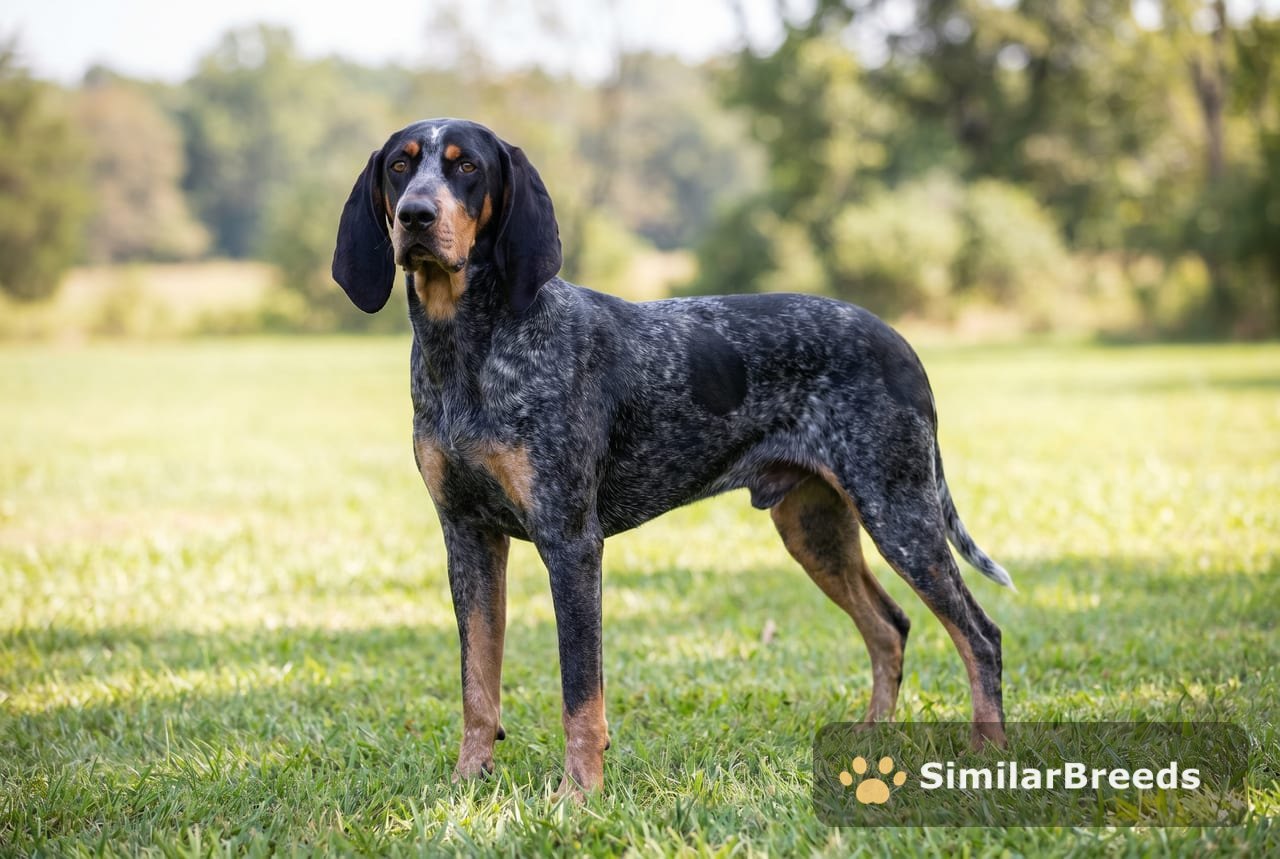
Purpose & Origin
The Bluetick Coonhound is an American scenthound built specifically for trailing and treeing raccoon, though it is equally capable on opossum, bear, mountain lion, and wild boar. Its roots trace to English hunting hounds brought to America in the seventeenth and eighteenth centuries. George Washington was among the early breeders, crossing English foxhounds with French hounds. Repeated infusions of the slow, methodical Grand Bleu de Gascogne produced dogs with distinctive black ticking and, crucially, the ability to work cold scent trails that faster hounds abandon. Much of the breed took shape in the Louisiana bayous and Tennessee Ozarks.
Initially classified as a variety of English Coonhound, breeders of blue-ticked dogs broke off when the English Coonhound fancy began chasing speed over persistence, and the UKC granted the Bluetick separate status in 1945. The AKC followed in 2009. Hunters prize this dog above almost all others for its refusal to quit on a difficult, confusing trail.
Temperament & Behaviour
The Bluetick is friendly, laid-back, and thoroughly independent. It gets along well with other dogs and, when raised alongside them, with other household animals. Strangers are generally greeted without suspicion. That easygoing quality is real, but it comes with a hound's selective hearing: when the nose locks onto something interesting, commands become background noise. Counter-surfing is a near-universal habit, and the breed is a capable escape artist. When excited, and especially when on trail, the Bluetick bays loudly, a deep, carrying bawl that carries considerable distance. This is not a trait that fades with training.
Activity & Training
The Bluetick is more endurance runner than sprinter, built to cover ground hour after hour. A daily long walk or jog is the baseline; the breed is calmest indoors when that need is met consistently. Given the chance to follow a scent trail through varied terrain, even suburban dogs benefit noticeably in mood and manageability. Off-leash exercise in an unfenced area is a poor idea, as the nose overrides recall reliably.
Formal obedience is an uphill task. With an ease-of-training score of 1 out of 5, the Bluetick ranks among the harder breeds to teach structured commands. Patience, food motivation, and low expectations for precision work are more realistic than crisp heel work or reliable stays.
Grooming
Grooming demands are minimal. The short, dense coat needs only occasional brushing to stay tidy. The Bluetick is not a heavy shedder and requires no trimming or stripping. Ears deserve routine attention, as the long, pendulous ear leather limits airflow and creates conditions for infection. Food security inside the house is a more pressing management concern than any coat care routine.
Health
The Bluetick is a generally hardy breed with a lifespan of eleven to thirteen years. Hip dysplasia and ear infections appear occasionally. Lysosomal storage disease has been noted in the breed, though it is uncommon. Hip evaluation is the one recommended screening test for breeding stock.
Why these breeds are similar
No similar breeds are currently listed for the Bluetick Coonhound in this database. The natural comparison group would be other American treeing scenthounds, such as the Redbone Coonhound, Black and Tan Coonhound, and Treeing Walker Coonhound, which share the same working purpose, loose trailing style, loud bay, and characteristic hound independence. This section will be populated as breed comparisons are confirmed.
Trait ratings
- Energy level
- 3/5
- Exercise requirements
- 3/5
- Playfulness
- 3/5
- Affection level
- 3/5
- Friendliness toward dogs
- 4/5
- Friendliness toward other pets
- 3/5
- Friendliness toward strangers
- 3/5
- Ease of training
- 1/5
- Watchdog ability
- 3/5
- Protection ability
- 2/5
- Grooming requirements
- 1/5
- Cold tolerance
- 3/5
- Heat tolerance
- 3/5
Breeds similar to Bluetick Coonhound
No similar breeds are mapped for Bluetick Coonhound yet - try browsing its FCI group or country of origin below.