Komondor
From Hungary
Purpose & Origin
The Komondor is one of the oldest livestock guardian breeds in the world, arriving in Hungary with the Huns, who brought the large, long-legged Russian Owtcharka as their flock protector. In Hungary the dog found its calling among the Magyar shepherds and their Racka sheep, a breed whose dense, curly wool closely resembled the Komondor's developing coat. That resemblance was no accident and no inconvenience: a dog that looked like a sheep could move quietly among the flock and launch a surprise defence against wolves.
The breed is documented in writing as far back as 1555, though it was clearly established long before that. Magyar shepherds valued the Komondor so highly that they refused to let it crossbreed, keeping the line pure for centuries. Some accounts credit the Komondor with eliminating the wolf from Hungary entirely. The first dogs reached America in 1933, and the AKC recognised the breed in 1937. World War II came close to wiping out the European population, but dedicated breeders saved it.
Temperament & Behaviour
The Komondor was bred to work alone on open plains, making decisions without a shepherd nearby, and that independence runs deep. It is not stubborn in a frivolous way; it simply weighs situations and acts on its own judgment, which can frustrate owners who expect instant compliance. It bonds closely with family and is affectionate toward those it considers its own, but it is reserved with strangers and can be aggressive toward unfamiliar dogs. Its watchdog and protection instincts score at the top of the scale, and it is at its most content when it has something to guard.
It is calm and quiet in settled conditions but utterly fearless when it perceives a threat. It does well with other pets and livestock, treating them as members of its charge. Children in the family are treated protectively, though rough play from visiting children can be misread as a threat.
Activity & Training
Daily exercise is moderate: long walks or a good romp in a secure yard satisfy this breed. Swimming should be avoided because the corded coat takes an extremely long time to dry and becomes a hygiene problem. The Komondor does not do well in heat and is far better suited to cold climates. Training requires a confident, consistent owner. This is not a dog for first-time owners or anyone who can be dominated. Socialisation from puppyhood is essential, both with people and other dogs, to keep the breed's natural wariness from tipping into aggression.
Grooming
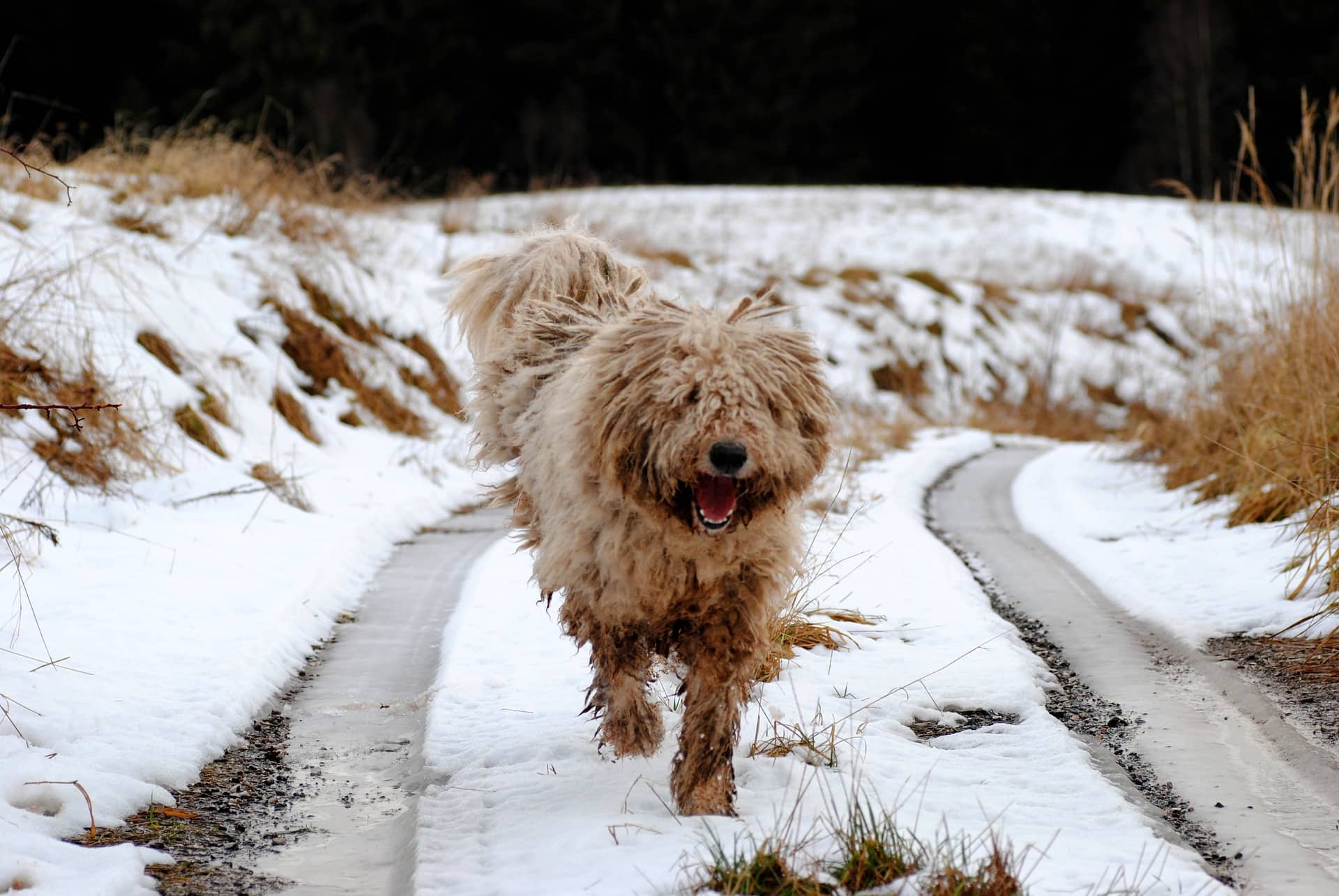
The corded coat looks dramatic and is genuinely demanding. The cords must be separated by hand on a regular basis; left alone they mat into flat, felted slabs. The coat holds dirt and dries slowly after bathing, sometimes requiring a full day to dry completely. Cords do not fully form until the dog is around two years old. Clipping is an option for pets but removes the breed's defining feature. Show preparation is so time-consuming that it limits how many dogs actually enter the ring, which contributes to the breed's rarity outside Hungary.
Health
The Komondor's main health concerns are hip dysplasia and gastric torsion (bloat), the latter being a serious risk in deep-chested breeds of this size. Minor issues include ear infections and hot spots, with entropion seen occasionally. Hip and eye testing is recommended. Life expectancy is 10 to 12 years.
Why these breeds are similar
No similar breeds are recorded in the source data for the Komondor at this time.
Trait ratings
- Energy level
- 3/5
- Exercise requirements
- 3/5
- Playfulness
- 3/5
- Affection level
- 4/5
- Friendliness toward dogs
- 1/5
- Friendliness toward other pets
- 4/5
- Friendliness toward strangers
- 1/5
- Ease of training
- 3/5
- Watchdog ability
- 5/5
- Protection ability
- 5/5
- Grooming requirements
- 3/5
- Cold tolerance
- 4/5
- Heat tolerance
- 2/5
Breeds similar to Komondor
No similar breeds are mapped for Komondor yet - try browsing its FCI group or country of origin below.