Puli
From Hungary
Purpose & Origin
The Puli is a Hungarian herding dog whose ancestors arrived in the Carpathian Basin with Magyar tribes migrating from the eastern Urals around the ninth century. Some researchers note a structural resemblance to the Tibetan Spaniel and suggest an Asian strain in the breed's background, though the working dog that emerged in Hungary was shaped entirely by the demands of the Hungarian plain. The black coat was not incidental: shepherds needed to pick out the small daytime herder against a flock of pale sheep, while larger dogs handled nighttime guarding.
The Puli was nimble enough to redirect a stubborn ewe by jumping onto its back. After Ottoman invasions devastated Hungary in the sixteenth century, incoming western European dogs crossbred with surviving Pulik and produced the Pumi, nearly erasing the original type. A formal recovery effort in the early twentieth century produced the first written standard in 1925, and the AKC recognised the breed in 1936 after the US Department of Agriculture imported several dogs to test their herding potential.
Temperament & Behaviour
The Puli is intensely alert and has a watchdog instinct that sits at the top of the scale. It is not a breed that tolerates strangers comfortably, and it is prone to aggression toward other dogs. With its own family it is protective and loyal, though it is not especially demonstrative. Expect noise: the Puli barks readily and takes its sentinel role seriously. This is a headstrong, independent-minded dog, and it does not defer to people automatically. First-time owners often find that combination of strong will and reserved affection harder to manage than they anticipated.
Activity & Training
The Puli has high energy and needs real daily exercise, a brisk walk or jog, or an active training session. It does best with a task or at least the structure that regular training provides. Its intelligence is genuine, but ease of training is low because the breed tends to think for itself rather than follow directions. Consistent, confident handling from the start matters; this is not a dog that responds to casual repetition. A bored or under-exercised Puli will find its own outlets, usually loud or destructive ones.
Grooming
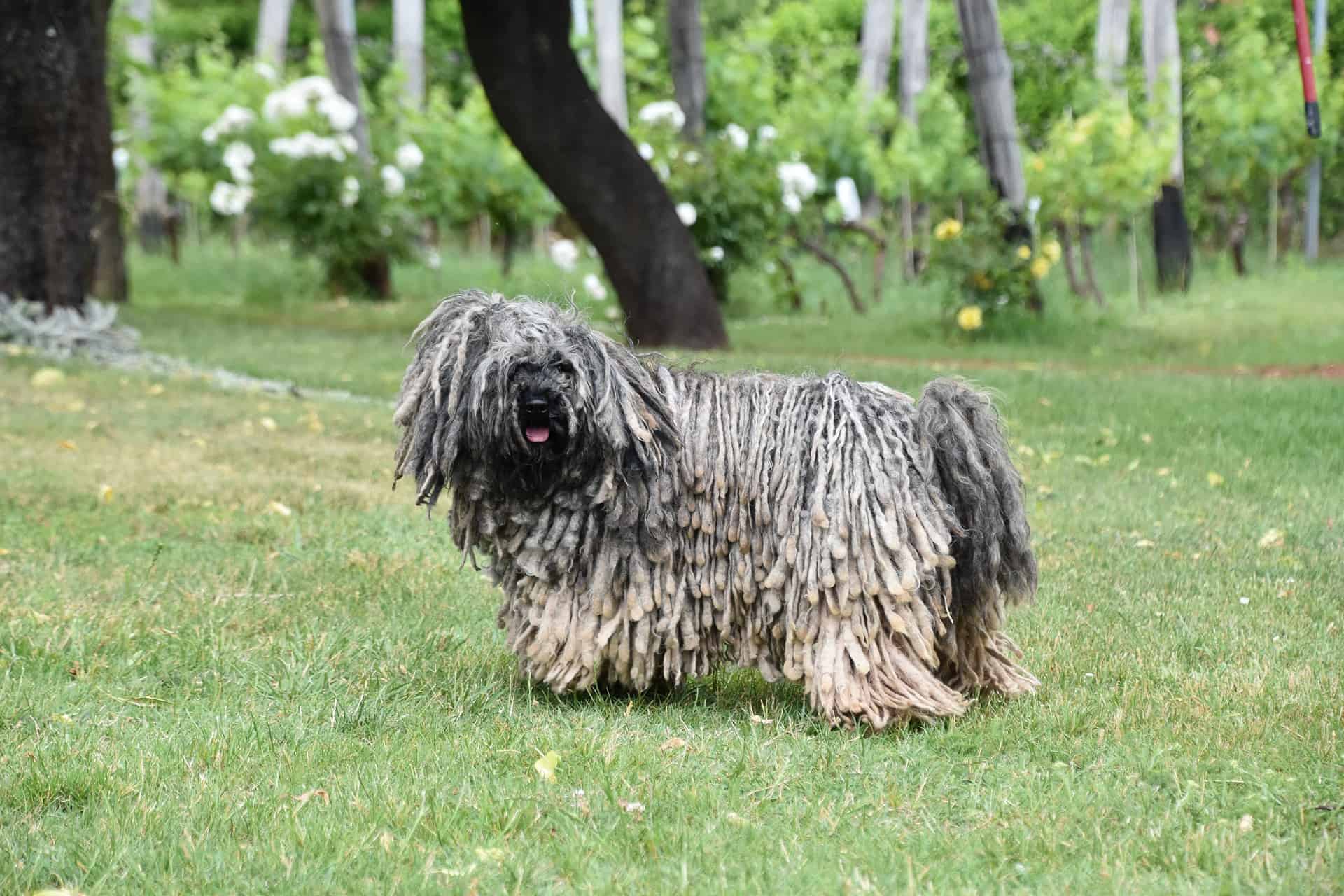
The Puli's coat demands more time than almost any other breed. It does not shed, but the dense, woolly undercoat and coarser outer coat naturally mat into cords if left unmanaged. Owners can either brush the coat every one to two days to keep it loose, or deliberately separate and maintain the cords. The corded coat traps dirt and debris and takes a full day to dry after bathing. Pets whose owners do not intend to show or cord the coat are often clipped short, which is the most practical route for anyone who cannot commit to the grooming overhead.
Health
Hip dysplasia is the primary concern in the breed. Progressive retinal atrophy, deafness, degenerative myelopathy, and patellar luxation appear occasionally. Recommended health screens cover hips, eyes, hearing, knees, and a DNA test for degenerative myelopathy. Typical lifespan is ten to fifteen years.
Why these breeds are similar
The Komondor is the most direct relative: also Hungarian, also corded, and developed on the same plains to work alongside the Puli. Where the Puli herded by day, the larger Komondor guarded flocks at night, and the two breeds share that reserved, protective temperament and the same extraordinary coat maintenance burden. The Pumi is the Puli's closer genetic sibling, the breed that nearly absorbed it after the sixteenth-century population collapse; the Pumi is more terrier-like and quicker to engage, but shares the herding background, the strong voice, and the independence.
The Bergamasco Shepherd is an Italian herding breed with its own corded coat and the same livestock-guardian wariness of strangers, offering a southern European parallel to the Puli's Hungarian type. The Briard is a French herding breed of similar energy and drive, equally reserved with outsiders and equally demanding of an experienced handler, though it wears a long flat coat rather than cords.
Trait ratings
- Energy level
- 4/5
- Exercise requirements
- 3/5
- Playfulness
- 3/5
- Affection level
- 2/5
- Friendliness toward dogs
- 1/5
- Friendliness toward other pets
- 3/5
- Friendliness toward strangers
- 1/5
- Ease of training
- 2/5
- Watchdog ability
- 5/5
- Protection ability
- 5/5
- Grooming requirements
- 5/5
- Cold tolerance
- 4/5
- Heat tolerance
- 2/5
Breeds similar to Puli
No similar breeds are mapped for Puli yet - try browsing its FCI group or country of origin below.